
Background
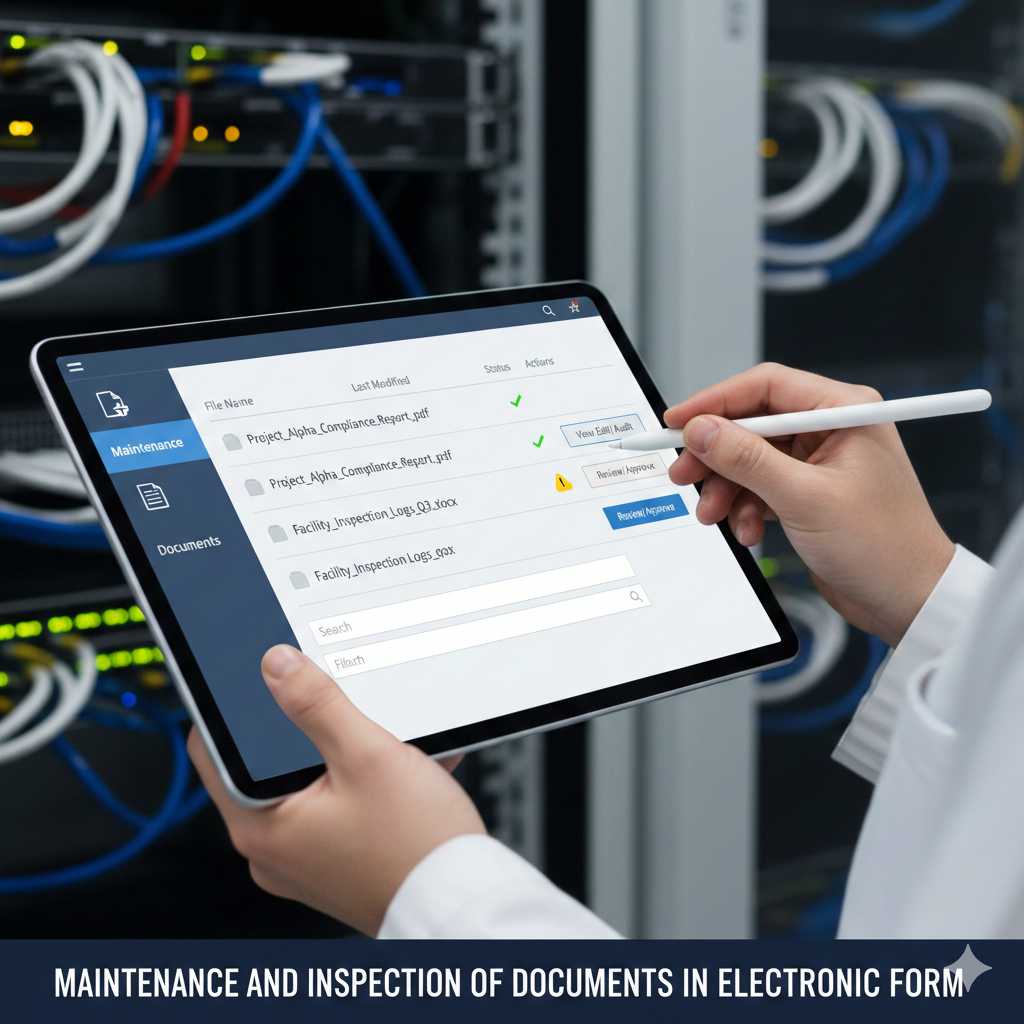
Section 120 of the Companies Act, 2013 recognizes and facilitates the maintenance of corporate records in electronic form, marking a significant departure from the traditional paper-based record-keeping regime. The operational framework for implementation of Section 120 is provided under Rule 27 of the Companies (Management and Administration) Rules, 2014 (“the Rules”), which prescribes the conditions, safeguards, and technical requirements for maintenance and inspection of documents in electronic form. The conjunction of Section 120 and Rule 27 creates a comprehensive regulatory architecture that balances the benefits of digitalization with the imperatives of security, authenticity, and regulatory compliance.
Applicability
Every listed company or a company having not less than one thousand shareholders, debenture holders and other security holders, may maintain its records, as required to be maintained under the Act or rules made there under, in electronic form.
Compliance Requirements under the Act in Accordance with the Rules
The provision is prefaced with the non-obstante clause “without prejudice to any other provisions of this Act,” thereby clarifying that the enabling provisions for electronic maintenance of documents operate in addition to, and not in derogation of, other provisions of the Act. Section 120 applies to any document, record, register, minutes, or other such corporate records that are either required to be kept by a company under clause (a), or allowed to be inspected or copies given to any person by a company under the Act as per clause (b). Such documents may be kept, inspected, or copies given, as the case may be, in electronic form in such form and manner as may be prescribed.
Rule 27(2) provides that the records in electronic form shall be maintained in such manner as the Board of Directors of the company may think fit, thereby vesting discretion in the Board to determine the specific systems, platforms, and protocols for electronic record-keeping. However, this discretion is not absolute and is subject to the mandatory conditions and safeguards specified in the proviso to Rule 27(2), which contains six distinct requirements that must be satisfied.
Proviso (a) to Rule 27(2) mandates that the records are maintained in the same formats and in accordance with all other requirements as provided in the Act or the rules made thereunder. This provision ensures that the shift from physical to electronic mode does not result in any dilution of the substantive content or format requirements prescribed under various provisions of the Act and the Rules. For instance, if a particular register is required to contain specific columns or particulars under the relevant rules, the electronic version must replicate the same structure and information fields. The electronic format must be functionally and substantively equivalent to the prescribed physical format.
Proviso (b) requires that the information as required under the provisions of the Act or the rules made thereunder should be adequately recorded for future reference. This provision addresses the permanence and completeness aspects of electronic record-keeping. The term “adequately recorded” implies that all mandated information must be captured comprehensively and preserved in a manner that ensures its availability for future retrieval and reference. The electronic system must incorporate mechanisms to prevent loss, corruption, or degradation of data over time, thereby ensuring that records remain accessible and usable throughout their prescribed retention periods.
Proviso (c) mandates that the records must be capable of being readable, retrievable, and reproducible in printed form. This tripartite requirement ensures practical usability of electronic records. “Readable” implies that the records must be capable of being viewed and comprehended in electronic format by authorized persons without requiring specialized or proprietary tools that may not be readily available. “Retrievable” mandates that the system must enable searching, locating, and accessing specific records or information within records efficiently, without necessitating manual review of large volumes of data. “Reproducible in printed form” requires that electronic records must be capable of being converted to hard copy format when necessary, ensuring that physical copies can be produced for inspection, submission to authorities, or use in legal proceedings.
Proviso (d) requires that the records are capable of being dated and signed digitally wherever it is required under the provisions of the Act or the rules made thereunder. This provision recognizes that numerous provisions of the Act mandate authentication of documents through signatures of directors, secretaries, or other officers. In the electronic environment, such authentication is achieved through digital signatures as defined under the Information Technology Act, 2000. The electronic record-keeping system must therefore incorporate digital signature infrastructure that enables authorized persons to affix their digital signatures to records. The dating capability ensures that the temporal aspect of record creation or modification is captured with precision and cannot be manipulated.
Proviso (e) provides that the records, once dated and signed digitally, shall not be capable of being edited or altered. This provision addresses the critical concern of maintaining integrity and authenticity of executed documents. Once a record has been digitally signed, the system must prevent any modification to its content, thereby ensuring that what was authenticated remains unchanged. This requirement typically necessitates implementation of cryptographic hashing or similar technologies that detect any post-signature tampering and render the digital signature invalid if alteration occurs. The immutability of digitally signed records provides assurance comparable to, or exceeding, that provided by wet signatures on physical documents.
Proviso (f) requires that the records shall be capable of being updated according to the provisions of the Act or the rules made thereunder, and the date of updating shall be capable of being recorded on every updating. This provision recognizes that certain corporate records, such as registers of members, directors, or charges, are dynamic in nature and require periodic updating to reflect changes in relevant facts. While proviso (e) mandates immutability post-signature, proviso (f) addresses the need for legitimate updates to records that are ongoing in nature. The system must therefore distinguish between unauthorized alteration (which is prohibited) and authorized updating (which is permitted but must be tracked). The requirement to record the date of every updating creates an audit trail that documents when each modification was made, thereby enabling reconstruction of the evolution of the record over time and facilitating detection of unauthorized changes.
The Explanation to Rule 27(2) provides an inclusive definition of the term “records” for the purposes of the rule. It states that “records” means any register, index, agreement, memorandum, minutes, or any other document required by the Act or the rules made thereunder to be kept by a company. This definition is expansive and non-exhaustive, as indicated by the use of the phrase “any other document.” The specific mention of registers, indices, agreements, memoranda, and minutes illustrates the types of documents contemplated, while the residuary category ensures that all documents mandated under the Act or Rules are covered.
While Rule 27 primarily addresses maintenance of documents in electronic form, Section 120 explicitly extends to inspection of documents and provision of copies. The provision states that documents may be “inspected or copies given” in electronic form. This enables companies to facilitate statutory inspections through electronic means, such as providing access to documents through secure portals or electronic viewing facilities, rather than requiring physical inspection at the registered office. Similarly, when members or other stakeholders are entitled to receive copies of documents under various provisions of the Act, such copies may be provided in electronic form, such as through email transmission or download links, subject to compliance with prescribed safeguards.
Penalty & Punishment
Where no penalty is provided elsewhere, as per Section 450, the company and every officer of the company who is in default or such other person shall be liable to a penalty of ten thousand rupees, and in case of continuing contravention, with a further penalty of one thousand rupees for each day after the first during which the contravention continues, subject to a maximum of two lakh rupees in case of a company and fifty thousand rupees in case of an officer who is in default or any other person.
Disclaimer: The information contained in this Article is intended solely for personal non-commercial use of the user who accepts full responsibility of its use. The information in the article is general in nature and should not be considered to be legal, tax, accounting, consulting or any other professional advice. We make no representation or warranty of any kind, express or implied regarding the accuracy, adequacy, reliability or completeness of any information on our page/article.