
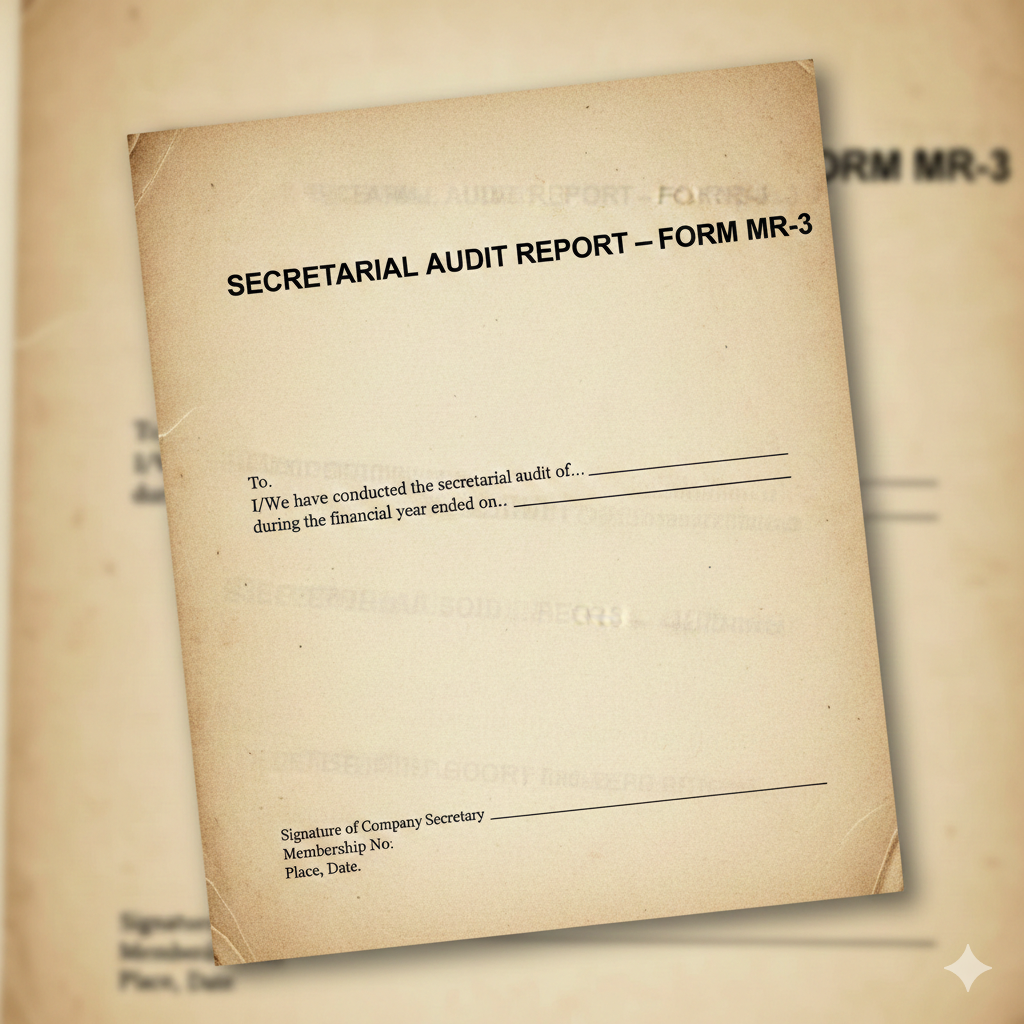
Secretarial Audit Report – Form MR-3

Background

Secretarial Audit is a key governance mechanism introduced under Section 204 of the Companies Act, 2013 to ensure that companies comply with applicable laws, rules, regulations, and secretarial standards. It provides an independent verification of the company’s compliance framework and strengthens transparency in corporate operations. The audit is conducted by a Company Secretary in Practice, and the report is submitted in Form MR-3 as part of the Board’s Report under Section 134.

Applicability

Mandatory for:

    • All listed companies;
    • Public companies with paid-up share capital of ₹50 crore or more;
    • Public companies with turnover of ₹250 crore or more;
    • Companies having outstanding loans or borrowings from banks or public financial institutions of ₹100 crore or more.

Timeline:

    • Secretarial Audit to be conducted annually for the financial year.
    • Form MR-3 to be annexed to the Board’s Report issued under Section 134 and circulated to shareholders along with the annual report.

Compliance Requirements:

    • Every listed company and such other prescribed class of companies must annex a Secretarial Audit Report to the Board’s Report. The report is to be issued by a Company Secretary in Practice in the prescribed format, i.e., Form MR-3.
    • The company is required to provide all necessary assistance, information, and facilities to the practicing Company Secretary to enable proper examination of secretarial and related records. The Secretarial Audit evaluates compliance with the Companies Act, applicable rules, secretarial standards, and other corporate laws as applicable to the company.
    • If the Secretarial Audit Report contains any qualifications, observations, or adverse remarks, the Board of Directors is required to provide detailed explanations in the Board’s Report.

As per Rule 9, the Secretarial Audit requirement applies not only to listed companies but also to the following classes of companies:

    • Every public company having paid-up share capital of ₹50 crore or more; or
    • Every public company having turnover of ₹250 crore or more; or
    • Every company having outstanding loans or borrowings from banks or public financial institutions of ₹100 crore or more.

For determining applicability, the paid-up share capital, turnover, or outstanding loans/borrowings as per the latest audited financial statements as on the last date of the financial year must be considered.

Penalty & Punishment:

In case of contravention of Section 204:

    • The company, every officer in default, and the Company Secretary in Practice shall be liable to a penalty of ₹2,00,000.


Disclaimer: The information contained in this Article is intended solely for personal non-commercial use of the user who accepts full responsibility of its use. The information in the article is general in nature and should not be considered to be legal, tax, accounting, consulting or any other professional advice. We make no representation or warranty of any kind, express or implied regarding the accuracy, adequacy, reliability or completeness of any information on our page/article. 

To stay updated Subscribe to our newsletter today

Explore other Legal updates on the 1-Comply and follow us on LinkedIn to stay updated 

Post Views: 54

Schedule A Demo