
Background
The concept of share ownership in India has evolved from traditional physical share certificates to electronic holding through the depository system. While a share certificate remains a statutory document evidencing title, the regulatory shift under Rule 9A and Rule 9B mandates dematerialisation for specified classes of companies.
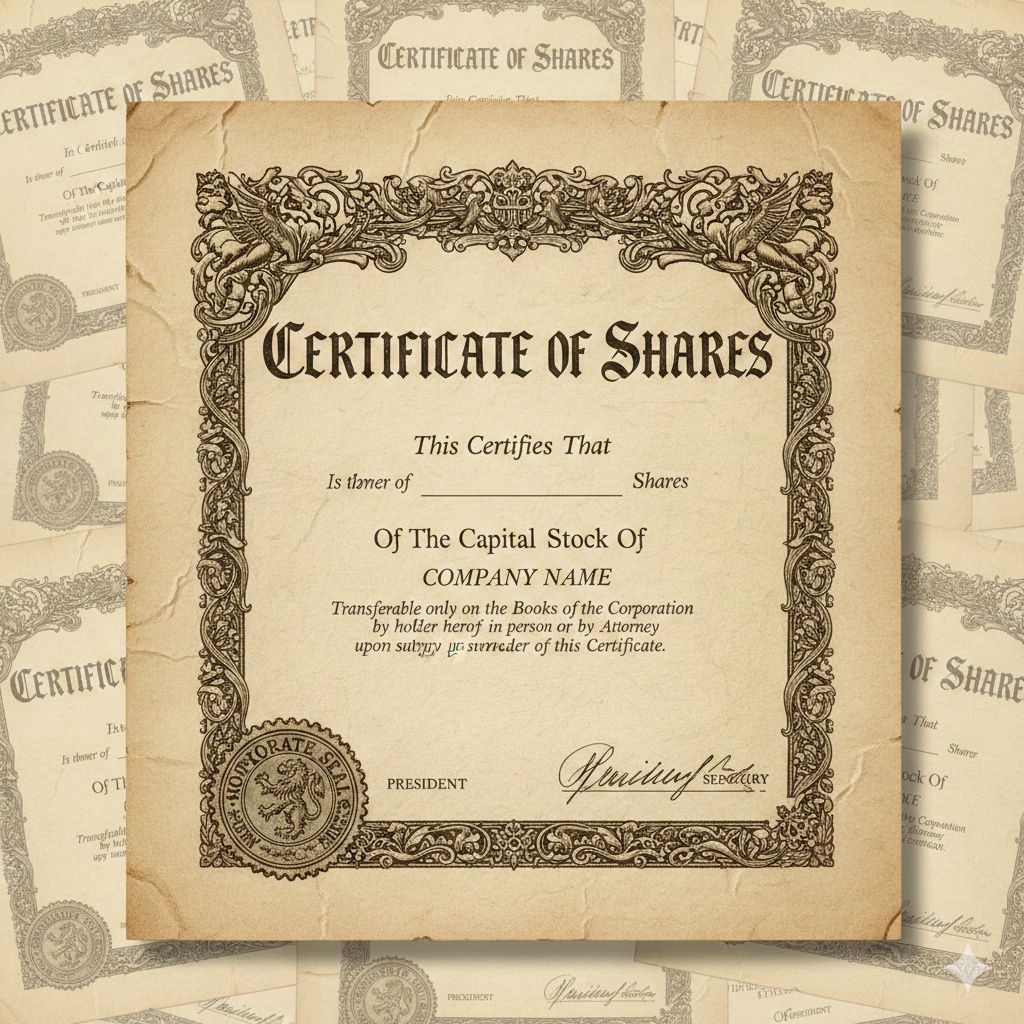
A share certificate is a document issued under the common seal (if any) of a company, or signed by two directors or by a director and the company secretary (where appointed), specifying the shares held by any member.
The governing framework includes:
This article explains the legal position of share certificates and the mandatory dematerialisation regime under Rule 9A and Rule 9B.
Requisites for Issuing Share Certificate
The process of issuing share capital begins with allotment of shares.
2. Distinctive Numbering (Section 45)
Every share must be assigned a distinctive number.
Exception:
Not applicable where shares are held in dematerialized form and recorded with a depository.
Compliance Requirements
Part I – Share Certificate under the Companies Act, 2013
As per Rule 5 of the Companies (Share Capital and Debentures) Rules, 2014:
Details must also be recorded in the Register of Members under Section 88.
Special Provisions
One Person Company (OPC)
Facsimile Signatures
Signatories are personally responsible for signature security
2. Duplicate Share Certificates
A duplicate certificate may be issued if:
Fraudulent issue of duplicate certificates attracts severe penalties under Section 447 (Fraud).
Time Frame for Issuing Share Certificate
After incorporation, a company is required to issue share certificates to its subscribers within a period of two months from the date of incorporation. In the event of further allotment of shares to new or existing shareholders, the corresponding share certificates must be issued within two months from the date of allotment. In cases involving transfer of shares, the company must deliver the share certificates to the transferees within one month from the date of receipt of the duly executed instrument of transfer.
Part II– Shift to Dematerialisation
Dematerialisation (“demat”) is the process of converting physical share certificates into electronic form held with a depository.
Under the Depositories Act, 1996, securities held in electronic form are evidenced by depository records, which serve as prima facie proof of ownership.
In demat mode:
Part III – Rule 9A: Issue of securities in dematerialised form by unlisted public companies
Effective from 2 October 2018
Mandatory Requirements under Rule 9A
Unlisted public companies must:
Before undertaking:
The entire holding of promoters, directors, and KMPs must be in dematerialised form.
Shareholder Obligations
Compliance and Reporting
Exemptions under Rule 9A
Rule 9A does not apply to:
Note: Section 8 companies having share capital are also required to abide this rule.
Part IV – Rule 9B: Issue of Securities in Dematerialised form by Private Companies
Applicability: Private Company which is not a *Small Company
Rule 9B inserted after Rule 9A, viz.:
*Small Company means a company, other than a public company,—
(i) paid-up share capital of which does not exceed ten crore rupees and
(ii) turnover of which as per profit and loss account for the immediately preceding financial year does not exceed one hundred crore rupees.
Provided that nothing in this clause shall apply to—
(A) a holding company or a subsidiary company;
(B) a company registered under section 8; or
(C) a company or body corporate governed by any special Act;
Exemption
Government companies are exempt from Rule 9B.
Note: Section 8 companies having share capital are also required to abide this rule
Part- V: Issue of Duplicate Share Certificate – This shall not be applicable where the shares are required to be issued/converted in demat mode.
Part- VI: Control, Custody & Record Management
After issuance, strict control mechanisms apply.
2. Custodial Responsibility
Custody entrusted to:
Custodian accountable to Board.
3. Preservation of Documents
Minimum Preservation: 30 years for all books and documents.
Disputed Cases: Permanent preservation.
Surrendered Certificates
Exception:
Not applicable where cancellation occurs under the Depositories Act in compliance with SEBI regulations.
Part VII: Grievance Redressal
Security holder grievances are adjudicated by the:
The Authority coordinates with SEBI before initiating action against:
Penalty & Punishment
Disclaimer: The information contained in this Article is intended solely for personal non-commercial use of the user who accepts full responsibility of its use. The information in the article is general in nature and should not be considered to be legal, tax, accounting, consulting or any other professional advice. We make no representation or warranty of any kind, express or implied regarding the accuracy, adequacy, reliability or completeness of any information on our page/article.