
Background
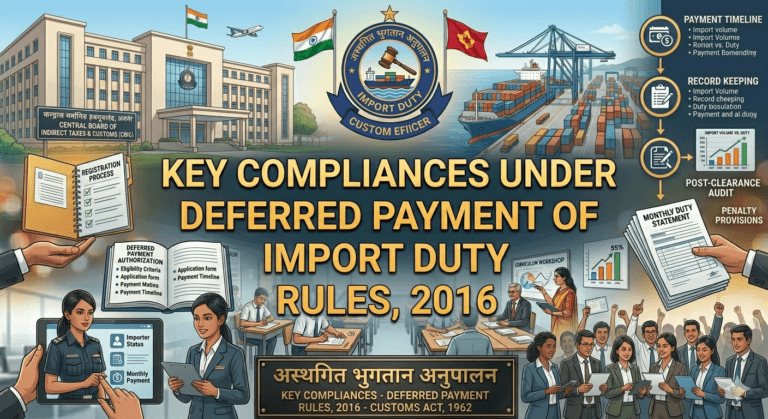
The Deferred Payment of Import Duty Rules, 2016 were introduced to improve ease of doing business by allowing eligible importers to pay customs duty at a later date instead of at the time of clearance. Framed under the Customs Act, 1962, the rules aim to reduce cash-flow burden, speed up cargo clearance, and support compliant importers, especially Authorized Economic Operators (AEOs).
Applicability
These rules are applicable to:
Importers certified as AEO Tier-Two or Tier-Three/Authorized Public Undertaking, eligible manufacturer Importers
Compliance Requirements
An eligible importer intending to avail the benefit defered payment of import duty under section 47(1) of the Act must inform the Principal Commissioner or Commissioner of Customs having jurisdiction over the port of clearance about such intention.
Note: Erstwhile Rule 4 omitted vide Notification No. 79/2020- Cus. (N.T.), dated 19-08-2020
The eligible importer must pay duty within the period specified under section 47(2) of the Act, excluding holidays. For goods with Bills of Entry returned for payment between the 1st and last day of any month other than March, duty must be paid by the 1st day of the following month & for goods corresponding to BoE returned for payment from 1st day to 31st day of March, by 31st March
The eligible importer shall pay duty electronically. However, the Assistant or Deputy Commissioner of Customs may, for reasons recorded in writing, permit payment of duty through a mode other than electronic payment. Nothing contained in these rules shall apply to the goods which have not been assessed or not declared by the importer in the entry made under the Act.
An eligible importer who fails to pay duty in full by due date more than once in a period of 3 consecutive months shall not be permitted to make deferred payment. The facility of deferred payment shall not be restored unless the eligible importer has paid the duty in full along with the interest.
Provided further that the eligible importer shall be permitted to make the deferred payment if he has- (i) paid the duty for a bill of entry within due date in terms of rule 4; and (ii) paid the differential duty for the same bill of entry along with the interest on account of reassessment within one day (excluding holidays). Nothing contained in these rules shall apply to the goods which have not been assessed or not declared by the importer in the entry made under the Act.
Disclaimer: The information contained in this Article is intended solely for personal non-commercial use of the user who accepts full responsibility of its use. The information in the article is general in nature and should not be considered to be legal, tax, accounting, consulting or any other professional advice. We make no representation or warranty of any kind, express or implied regarding the accuracy, adequacy, reliability or completeness of any information on our page/article.