
Background
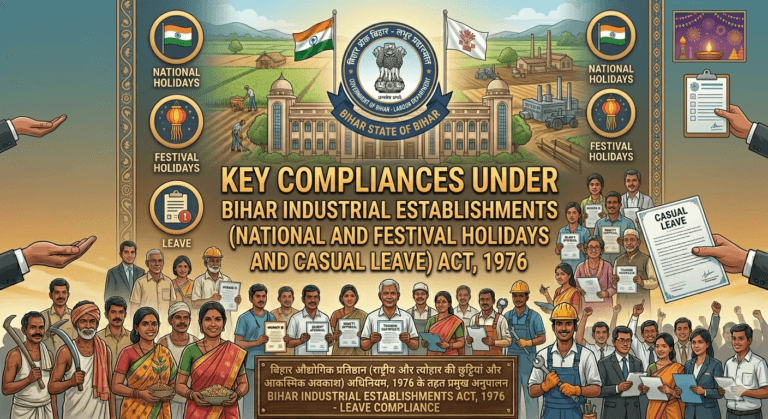
The Bihar Industrial Establishments (National and Festival Holidays and Casual Leave) Act, 1976 was enacted to regulate grant of national/festival holidays and casual leave for employees in industrial establishments. After the creation of Jharkhand in 2000, the Act was adopted by the state to ensure uniform leave benefits and worker welfare along with Bihar Industrial Establishments (National and Festival Holidays and Casual Leave) Rules, 1979. It aims to provide statutory holidays, leave entitlements, and maintain proper records. The law also balances employee rights with employer obligations for compliance and inspections.
Applicability
The compliances referred herein shall be applicable to Industrial Establishment being a factory and plantation in the State of Jharkhand.
Nothing contained in this Act shall apply to –
(a) any such employee who gets monthly wages of more than five hundred rupees and be chiefly employed
on a managerial administrative or supervisory post;
(b) any industrial establishment under the control of the Central Government or the State Government; and
(c) any mine or oil field.
Compliance Requirements under the Act in accordance with the Rules
Every employee shall be granted following holidays in each calendar year in such manner and on such terms and conditions as may be prescribed: –
(a) Three National Holidays on the 26th January, 15th August and the 2nd October.
(b) Four other holidays on any festival out of the festivals mentioned in the Schedule.
(c) International Labour day on 1st May.
Employees cannot be required to work on National Holidays under Section 3(1)(a) or on 1st May unless the management provides at least 48 hours’ prior notice. A copy of this notice must also be displayed on the establishment’s notice board.
Every industrial establishment must maintain a register in the prescribed Form I containing details of employees required to work on a National Holiday or on 1st May.
At the beginning of each calendar year, or within 60 days of starting operations for a new establishment, the employer must display a notice asking employees to indicate their choice of four festival holidays from the prescribed list under Section 3(1)(b) as:
1. New Year’s day.
2. Id-Uz-Zoha.
3. Basant Panchami.
4. Good Friday.
5. Holi.
6. Id-Ud-Zoha.
7. Muharram.
8. Dashahara.
9. Diwali.
10. Christmas Day.
11. Guru Govind Singh Birthday.
12. Ram Navami.
13. Birthday of Bhagwan Mahabir.
13. Janmashtami.
14. Vishwakarma Diwas.
15. Budh Purnima.
16. Chhath.
17. Makar Sankranti.
18. Guru Nanak Birth-day.
19. Bhaiya Dooj.
20. Maha-Shivaratri
21. Raksha Bandhan.
22. Sarhul.
Every employee should be allowed to avail festival holidays as per their indicated choice. However, if management requires employees to work on such days, it must record reasons and provide at least 3 days’ prior notice. This balances operational needs with employee rights.
1. New Year’s day.
2. Id-Uz-Zoha.
3. Basant Panchami.
4. Good Friday.
5. Holi.
6. Id-Ud-Zoha.
7. Muharram.
8. Dashahara.
9. Diwali.
10. Christmas Day.
11. Guru Govind Singh Birthday.
12. Ram Navami.
13. Birthday of Bhagwan Mahabir.
13. Janmashtami.
14. Vishwakarma Diwas.
15. Budh Purnima.
16. Chhath.
17. Makar Sankranti.
18. Guru Nanak Birth-day.
19. Bhaiya Dooj.
20. Maha-Shivaratri
21. Raksha Bandhan.
22. Sarhul.
Every employer must maintain a Register of workers required to work on a Festival Holiday in Form No. 2 and make it available for inspection by the Inspector.
Every employee shall be granted at least seven days of casual leave annually, in addition to other applicable leave entitlements. Leave should generally be applied for 48 hours in advance, except in cases of illness. Employers cannot refuse valid leave requests without urgent reasons, and refused leave must be allowed before year-end. Proportionate leave applies to employees with less than one year of service, with specific exclusions under the Act.
Every employer must maintain a register of casual leave in Form No. 3 and make it available for inspection by employees and the Inspector.
Every employer must maintain an account of festival holidays for each employee in the prescribed format and allow employees to inspect their leave accounts.
Employers must pay wages for national holidays and casual leave. If an employee works on a holiday, they may choose either double wages or wages plus a substitute paid holiday within three days. Employees with less than one month of continuous service are not eligible for such benefits except for national holidays.
Every employer must maintain a bound inspection book for the industrial establishment and produce it whenever required by the Inspector.
Penalty & Punishment
U/s 9: Any employer who contravenes any provisions of sections or rule or order made under this Act
U/s 10: Whoever knowingly fails to produce on demand by an Inspector any register, record or notice which is required to be maintained under the provisions
Disclaimer: The information contained in this Article is intended solely for personal non-commercial use of the user who accepts full responsibility of its use. The information in the article is general in nature and should not be considered to be legal, tax, accounting, consulting or any other professional advice. We make no representation or warranty of any kind, express or implied regarding the accuracy, adequacy, reliability or completeness of any information on our page/article.