
Key Compliances under Tamil Nadu Industrial Establishments (National, Festival and Special Holidays) Act, 1958
The Tamil Nadu Industrial Establishments (National, Festival and Special Holidays) Act, 1958 along with Tamil Nadu Industrial Establishments (National and Festival Holidays) Rules, 1959 was enacted as a state-specific labour welfare legislation with the primary objective of ensuring that employees in industrial establishments receive statutorily mandated paid holidays.
Before this law, there was no uniform legal framework in the State governing the grant of national and festival holidays to industrial workers. Holiday practices varied widely across establishments, often depending on employer discretion, which led to inconsistencies and potential exploitation of workers’ rights. The Act was therefore introduced to standardize and regulate holidays across industrial establishments in Tamil Nadu.
Key Compliances under Assam Shops and Establishment Act, 2022
The Assam Shops and Establishments Act governs the regulation of working conditions, employment practices, and operational standards for shops and commercial establishments across the state. It lays down provisions relating to registration, working hours, leave entitlements, wages, health, safety, and welfare of employees to ensure fair and humane working conditions. The Assam Shops and Establishments Rules, 1976 also prescribe detailed compliance requirements for employers, including maintenance of registers, display of notices, and adherence to safety and welfare measures, thereby promoting transparency and accountability in establishments.
Key Compliances under Orissa Shops and Commercial Establishment Act, 1956
Orissa Shops and Commercial Establishment Act,1956 governs the regulation of working conditions, employment practices, and operational standards for shops and commercial establishments across the state. It lays down provisions relating to registration, working hours, leave entitlements, wages, health, safety, and welfare of employees to ensure fair and humane working conditions. Orissa Shops and Commercial Establishments Rules, 1958 also prescribe detailed compliance requirements for employers, including maintenance of registers, display of notices, and adherence to safety and welfare measures, thereby promoting transparency and accountability in establishments.
Key Compliances under Guidelines for Prevention of Misleading Advertisements and Endorsements for Misleading Advertisements, 2022
The Consumer Protection Act, 2019 marked a significant shift in India’s consumer law regime by introducing a structured product liability framework. The law expands accountability across the entire supply chain covering manufacturers, service providers, and sellers to ensure consumer safety, transparency, and fairness. In exercise of the powers conferred by section 18 of the Act, the Central Consumer Protection Authority hereby issues the guidelines for Prevention of Misleading Advertisements and Endorsements for Misleading Advertisements, 2022 to provide for the prevention of false or misleading advertisements and making endorsements relating thereto.
Product Liability under Consumer Protection Act, 2019: Compliance Framework & Penal Implications
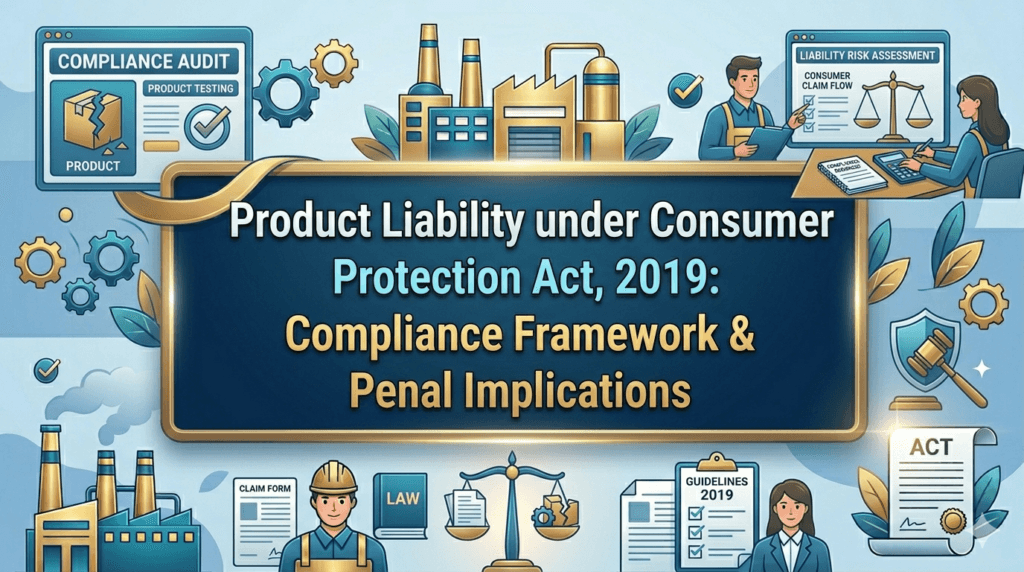
The Consumer Protection Act, 2019 marked a significant shift in India’s consumer law regime by introducing a structured product liability framework. The law expands accountability across the entire supply chain covering manufacturers, service providers, and sellers to ensure consumer safety, transparency, and fairness.
For businesses, especially manufacturers and service providers, this translates into strict compliance obligations backed by stringent penal provisions.
Key Compliances under Uttar Pradesh Fire and Emergency Services Act, 2022
The Uttar Pradesh Fire and Emergency Services Act, 2022 was enacted to modernize and strengthen fire safety and emergency response across the state by replacing and updating earlier fragmented fire laws. It aligns Uttar Pradesh’s fire and emergency framework with the Model Fire and Emergency Service Bill, 2019 circulated by the Government of India to bring uniformity in fire and rescue laws nationwide. The Act provides a statutory basis for improved fire prevention, preparedness, and emergency management, aiming to better protect life, property, and critical infrastructure.
Key Compliances under Madhya Pradesh Shops and Establishments Act, 1958
The Madhya Pradesh Shops and Establishments Act, read together with the Madhya Pradesh Shops and Establishments Rules, 1959, is a state-level labor welfare legislation that regulates working conditions in commercial establishments, shops, and related premises within the state of Madhya Pradesh.
Removal of Licensing Requirements, Stock Limits & Movement Restrictions on Specified Foodstuffs Order, 2016

The Essential Commodities Act, 1955 was enacted to ensure the availability of essential commodities to the general public and to prevent hoarding, black marketing, and profiteering. To strengthen food security, the Government has issued several control measures under this Act from time to time.
Jammu and Kashmir Government Order 552-PW(R&B) of 2018 dated 22.10.2018

The Jammu and Kashmir Government Order 552-PW(R&B) of 2018 was issued to regulate the installation, operation, and safety of lifts, escalators, and moving walkways within the state. The order prescribes mandatory registration, annual permissions, and safety protocols, ensuring that such installations meet prescribed technical and safety standards
Building Safety Certificate by Public Works Department (PWD), Government of Rajasthan

The Building Safety Certificate (BSC) is a crucial compliance document certifying that a building—public, semi-public, or institutional—has been constructed and maintained as per safety standards and structural stability norms.