
Uttar Pradesh Payment of Gratuity Rules, 1975
The Uttar Pradesh Payment of Gratuity Rules, 1975 were notified to implement the Payment of Gratuity Act, 1972 within the State of Uttar Pradesh. These rules lay down the procedure for employers and employees in matters of gratuity, including the format for notices, timelines for applications, methods of calculation, and the role of the Controlling Authority. The purpose is to ensure uniformity and clarity in gratuity administration across establishments in Uttar Pradesh.
Uttar Pradesh Payment of Wages Rules, 1936
The Uttar Pradesh Payment of Wages Rules, 1936, were framed under the Payment of Wages Act, 1936, to regulate timely and fair payment of wages to employees. The Rules lay down procedures regarding fixation of wage periods, time and mode of wage payment, permissible deductions, maintenance of registers, submission of returns, and display of statutory notices. They are designed to safeguard employees against wrongful deductions and delays, while also providing employers with a clear compliance framework.
Uttar Pradesh Workmen’s Compensation Rule, 1975
The Uttar Pradesh Workmen’s Compensation Rules, 1975 were framed under the Employees’ Compensation Act, 1923 (earlier called the Workmen’s Compensation Act, 1923). These Rules lay down procedural and administrative requirements for employers and employees in Uttar Pradesh. They govern aspects such as display of abstracts of the law in establishments, employer’s liability to pay compensation in case of accidents, compensation for death, disablement (temporary, partial, or permanent), reimbursement of medical expenses, registration of agreements, returns to be filed, and reporting of accidents. The purpose of the Rules is to ensure transparency, compliance, and prompt relief to employees or their dependants in case of employment-related injuries or death.
West Bengal Labour Welfare Fund Act, 1974
The West Bengal Labour Welfare Fund Act, 1974, was enacted to ensure the welfare and social security of workers employed in various establishments across the state. It provides for the constitution of the Labour Welfare Fund and the Labour Welfare Board, which utilize contributions from employers and employees, along with fines and unpaid accumulations, for the benefit of workers. The Act emphasizes improving the working and living conditions of employees through welfare measures.
West Bengal Payment of Gratuity Rules, 1973
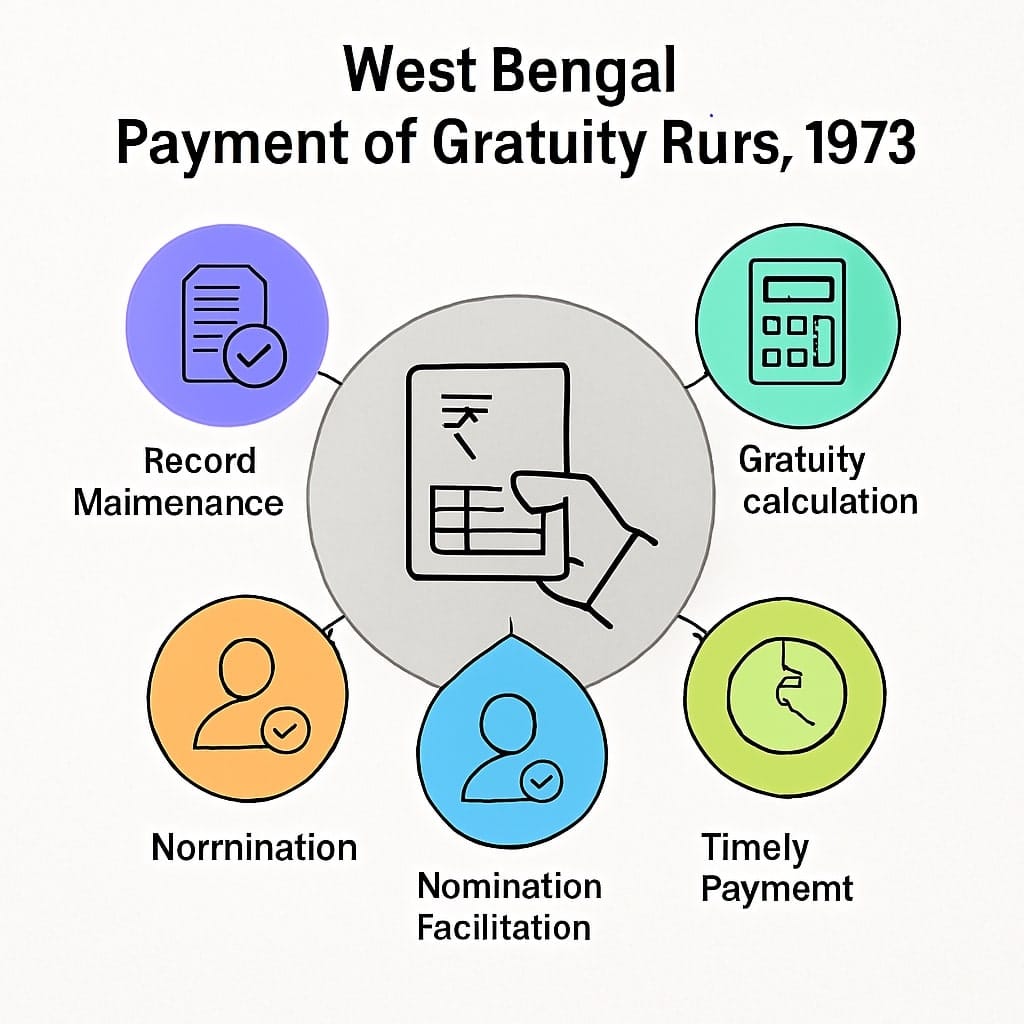
The West Bengal Payment of Gratuity Rules, 1973 were notified to implement the Payment of Gratuity Act, 1972 within the State of West Bengal. These rules lay down the procedure for employers and employees in matters of gratuity, including the format for notices, timelines for applications, methods of calculation, and the role of the Controlling Authority. The purpose is to ensure uniformity and clarity in gratuity administration across establishments in West Bengal.
West Bengal Payment of Wages Rules, 1958
The Payment of Wages Act, 1936 was enacted to regulate the timely payment of wages to certain classes of employed persons and to prevent unauthorized deductions. To give effect to the provisions of the Act, individual states framed their own rules. In West Bengal, the Payment of Wages Rules, 1958 were introduced, laying down detailed procedures regarding fixation of wage periods, maintenance of registers, permissible deductions, display requirements, and submission of returns. These rules were designed to safeguard workers’ interests, bring transparency to wage disbursement, and ensure accountability of employers.
Haryana: Punjab Payment of Wages Rules, 1937
The Haryana: Punjab Payment of Wages Rules, 1937, as extended to Haryana, have been framed under the Payment of Wages Act, 1936. These rules regulate the timely payment of wages, permissible deductions, maintenance of registers, display of notices, and the imposition of fines. The objective is to protect employees from arbitrary wage deductions, ensure transparency in wage administration, and provide legal recourse in case of violations.
Gujarat Industrial Dispute Rules, 1966
The Industrial Disputes Act, 1947, was enacted with the objective of maintaining industrial peace and harmony by providing a legal framework for the investigation and settlement of disputes between employers and workmen. The Act came into force on April 1, 1947, and extends to the whole of India, with the exception of Jammu and Kashmir (except in cases relating to workmen employed under the Government of India). Over the years, various states have framed rules to implement the provisions of the Act, and the Gujarat Industrial Disputes Rules represent one such framework. These rules provide detailed procedures for dispute resolution, formation of works committees, grievance redressal, retrenchment, lay-offs, closures, strikes, and lock-outs. Together, the Act and Rules aim to balance the rights of workmen and employers, ensuring industrial stability and fair treatment of workers while enabling businesses to function smoothly.
Single Integrated Annual Return Filing in West Bengal
The Government of West Bengal, in alignment with the Ease of Doing Business (EoDB) reforms and the mandate of the Labour Department, has introduced the system of Single Integrated Return Filing. This initiative consolidates multiple statutory returns that establishments were earlier required to submit separately under various labour legislations.
Kerala Municipality Act, 1994
The Kerala Municipality Act, 1994 was enacted to consolidate and amend the laws relating to municipalities in Kerala. It establishes a framework for the constitution, governance, powers, and responsibilities of municipal authorities. Among its provisions, it also prescribes levies such as Professional Tax, enabling municipalities to generate local revenue for public services and civic administration.