
Background
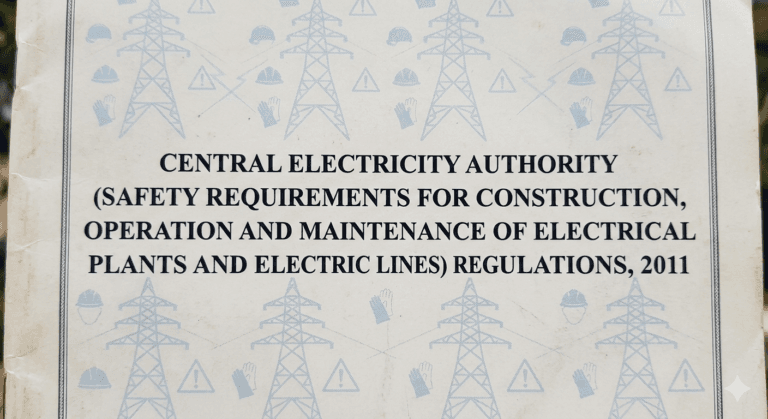
Central Electricity Authority (Safety Requirements for Construction, Operation and Maintenance of Electrical Plants and Electric Lines) Regulations, 2011 (CEA Safety Regulations, 2011) were notified by the Central Electricity Authority under Section 73 of the Electricity Act, 2003. These Regulations establish a binding framework governing safety requirement for owners of electrical plants and electric lines across all stages — construction, operation, and maintenance — to protect workers, contractors, visitors, and the public from hazards associated with electricity generation, transmission, and distribution.
Applicability
These Regulations shall be applicable to generating companies, transmission licensees, distribution licensees, Central Transmission Utility, State Transmission Utilities or any person
Note: The Regulations are applicable on Owner and owner includes employer under BOCW and employer has been defined under BOCW as inclusive of a contractor and def. of construction work includes electric lines, hence the regulations are applicable on contractor installing electric lines
Compliance Requirement Under Rules in Accordance with the Electricity Act, 2003:
The Owner shall obtain accreditation of electric plants with IS-18001 certification. The Owner shall make safety an integral part of work processes to ensure safety for all employees, including employees of contractors and sub-contractors, as well as visitors.
The Owner must establish a sound and scientific Safety Management System (SMS) which shall include: (a) a signed safety policy displayed at the premises; (b) defined responsibilities for all functional levels including contractors; (c) a statutory-compliant safety manual; (d) hazard identification and control procedures; (e) adequate human, physical and financial resources to implement the SMS; (f) a safe working environment and an Occupational Health and Safety (OHS) framework; (g) medical facilities; (h) adequate training to all employees; (i) a system for accident reporting, analysis, investigation and implementation of recommendations; (j) a system for proper communication, documentation and record management, either in certified soft or hard copy form, in relation to occupational safety and health; (k) an emergency management plan; (l) methodology for internal and external audit of the safety management system; (m) early warning systems; and (n) standard operating procedures for managing hazardous events.
Every Owner must prepare and implement a safety manual covering statutory requirements and manufacturer guidelines, ensuring it is site-specific or common for similar installations, and includes all safety aspects specified under the applicable schedules. The safety manual shall be site-specific; however, for similar installations, a common safety manual may be prepared and made applicable. Safety manuals shall cover all matters specified in Schedule-I (minimum 54 topics for construction, including safety policy, accident reporting, PPE, working at height, electrical safety, etc. under Para A; and Para B addresses additional requirements with respect to hydro-electric generating stations) and Schedule-II (additional safety manual requirements for operation and maintenance of electrical plants and electric lines).
The Owner must appoint a qualified Safety Officer when the total number of employees, including contract workers, exceeds 500, and one additional Safety Officer for every further 1,000 employees beyond 1,000. The officer must meet the qualifications prescribed under the Factories Act, 1948 or the Building and Other Construction Workers (Regulation of Employment and Conditions of Service) Act, 1996. Where multiple Safety Officers are appointed, one shall be designated as Chief Safety Officer, who shall hold a higher rank and oversee all safety functions. The Chief Safety Officer or Safety Officer shall hold senior executive status and report directly to the Chief Executive. The Safety Officer must be appointed before construction begins, and the safety setup chart displayed prominently at the site. The Safety Officer is empowered to stop unsafe work and remove employees or contract workers not following safety practices or not using PPE. The Safety Officer shall also organise regular safety training programmes and promote safety culture at the workplace.
Where the total number of employees, including contract workers, is less than five hundred, the Owner shall designate a suitable officer as Safety Officer. The designated Safety Officer must meet the qualifications prescribed under Section 40-B of the Factories Act, 1948 and rules made thereunder, or under sub-section (2) of Section 38 of the Building and Other Construction Workers (Regulation of Employment and Conditions of Service) Act, 1996. The Safety Officer shall hold senior executive status and report directly to the Chief Executive. They must be appointed before construction begins, with the safety setup chart displayed prominently. The Safety Officer shall assist the Owner in ensuring safety at the workplace, prevent injuries, and maintain safe conditions, and is empowered to stop unsafe work and remove non-compliant workers.
The Owner must constitute a Safety Committee when the total number of employees, including contract workers, exceeds 250. The committee shall have equal representation from management and employees, and shall include contractors during the construction stage. Management representation must include the Safety Officer and Medical Officer. The Safety Committee shall promote co-operation between workers and management for maintaining proper safety and health at the workplace. The committee shall meet at least once a month during the construction stage, and at least once every three months during operation and maintenance of electrical plants and electric lines. Decisions and recommendations of the Safety Committee shall be complied with by the Owner within the time limit decided by the committee.
Where the total number of employees, including contract workers, is two hundred and fifty or less, the Owner shall constitute a common Safety Committee for a group of electrical plants or electric lines. The committee shall promote co-operation between workers and management for maintaining proper safety and health at the workplace. The committee shall meet at least once a month during the construction stage and at least once every three months during operation and maintenance of electrical plants and electric lines, and the decisions and recommendations of the committee shall be complied with by the Owner within the time limit decided by the committee.
The Owner must include all applicable safety provisions in contracts and ensure compliance by contractors. The main contractor is responsible for ensuring that all safety measures are adhered to by sub-contractors and their employees. The contractor shall be responsible for non-compliance of safety measures, and for any implications, injuries, fatalities and compensation arising out of such situations or incidents. In the event of any accident, the contractor shall immediately submit a report to the Owner and the Safety Officer, containing details of the accident, any injury or casualties, extent of property damage, and remedial action taken to prevent recurrence.
Every contractor deploying 200 or more workers, including contract workers, must appoint a dedicated Safety Co-ordinator to ensure implementation of safety requirements under the contract. Contractors with fewer than 200 employees must nominate one of their employees as Safety Co-ordinator, who shall liaise with the Safety Officer on safety matters. The name of the Safety Co-ordinator must be displayed on the notice board at a prominent place at the work site. The Owner is obligated to ensure this requirement is met by all its contractors.
The Owner shall report to the Central Electricity Authority within twenty-four hours any cases of outage of an electrical plant or electric line due to any accident related to equipment — such as fire, explosion of pressure piping or pressure vessel, implosion, emission of hazardous chemicals, collapse of a transmission tower, or flooding of a power house area — whether or not any death or disablement is caused to any person. This reporting obligation applies to: (a) thermal generating units of 200 MW and above; (b) hydro-electric generating units of 50 MW and above; and (c) electric lines or sub-stations of 132 kV and above.
The Owner must prepare an on-site emergency management plan for thermal generating stations, hydro-electric generating plants, sub-stations, and groups of electric lines to handle emergencies including fire, floods, earthquakes, threats, and other hazardous events. The plan must ensure quick response and follow the provisions specified in Schedule-III of the Regulations. The on-site emergency management plan shall be prepared before the commencement of trial operation; for existing electrical plants and electric lines, it shall be prepared within ninety days from the date these Regulations came into force. For construction activities, an emergency action plan shall be prepared before commencement of construction to handle emergencies such as fire, explosion, collapse of lifting appliances or transport equipment, collapse of buildings or structures, gas leakages, landslides, floods, and earthquakes.
The Owner shall ensure that a mock drill of the on-site emergency management plan is conducted at least once every six months to test the effectiveness of the plan and ensure readiness of all personnel and resources to respond to emergencies.
The Owner must provide the District Collector with details of: industrial activities at the site; key employees of the emergency team; potential off-site accident scenarios; emergency team roles and responsibilities; coordination arrangements with nearby organisations; and a risk assessment including possible incidents, analysis, and impact evaluation. The information shall also include details of hazardous chemicals and fuels at the plant site (quantities, toxicological data, storage methods, and material safety data sheets); internal and external communication plans in case of emergency; and details of site facilities including fire-fighting equipment, diesel generating sets, dewatering facilities, rescue equipment, medical resources, and vehicles and mobile cranes.
The Owner shall provide medical facilities at the workplace: (a) to prevent and control occupational diseases; (b) to prevent and reduce disability; and (c) to provide immediate relief to accident victims.
Where the number of employees, including contract workers, working at one premises is fifty or less, an Occupational Health Centre with facilities as per the scale specified in Regulation 10(2)(a) shall be provided for all electrical plants and electric lines and maintained in good order. The required facilities include: (i) services of a Medical Officer on retainership basis, who shall carry out pre-employment and periodical medical examinations and render assistance during emergencies; (ii) a minimum of five persons trained in first-aid procedures, at least one of whom shall always be available during working hours; and (iii) a fully equipped first-aid box. The Medical Officer of the Occupational Health Centre shall also be involved in planning the emergency handling of large numbers of injured employees in the event of fire, explosion, natural calamities, or man-made disasters.
Where the number of employees, including contract workers, working at one premises is between 51 and 200, an Occupational Health Centre with facilities as per the scale specified in Regulation 10(2)(b) shall be provided and maintained in good order. The required facilities include: (i) an Occupational Health Centre equipped for health examination, diagnosis, treatment and maintenance of health records; (ii) a part-time Medical Officer as overall in-charge, who shall visit at least twice a week and whose services shall be available during medical emergencies; (iii) one qualified and trained dresser-cum-compounder on duty throughout working hours; and (iv) a fully equipped first-aid box in all departments. The Medical Officer shall be involved in planning emergency handling of large numbers of injured employees during fire, explosion, natural calamities, or man-made disasters.
Where the number of employees, including contract workers, working at one premises is more than 200, an Occupational Health Centre with facilities as per the scale specified in Regulation 10(2)(c) shall be provided and maintained in good order. The required facilities include: (i) an Occupational Health Centre equipped for health examination, diagnosis, treatment and maintenance of health records; (ii) one full-time Medical Officer for premises employing up to 500 workers and one additional Medical Officer for every additional 1,000 workers; (iii) one nurse, one dresser-cum-compounder and one sweeper-cum-ward boy throughout working hours; and (iv) the Occupational Health Centre shall be suitably equipped to manage medical emergencies. The Medical Officer shall be involved in planning emergency handling of large numbers of injured employees during fire, explosion, natural calamities, or man-made disasters.
The Owner shall ensure that a fully equipped ambulance van is provided at the site for prompt transportation of serious cases of accident or sickness to the hospital, and that such ambulance van is maintained in good condition and equipped with all necessary facilities. Where the number of employees, including contract workers, is less than two hundred, the Owner may instead make arrangements for procuring such a facility at short notice from a nearby hospital or other place, to meet any emergency.
The Owner must implement a programme for periodic medical check-ups of employees and maintain records of the same. As a minimum requirement, a pre-employment medical examination shall be carried out once before employment to ascertain the physical fitness of the person to perform the particular job assigned.
The Owner shall ensure that medical check-ups of all employees are conducted at intervals not exceeding twelve months. Records of all such medical examinations shall be maintained.
The Owner must conduct colour vision tests and eyesight examinations annually for drivers, skilled workers, technicians, supervisors, and crane operators who are below forty-five years of age.
The Owner must conduct colour vision tests and eyesight examinations every six months for drivers, skilled workers, technicians, supervisors, and crane operators who are above forty-five years of age.
The Owner must conduct tests for respiratory disorders for employees exposed to a dusty environment in power generating stations once every six months. This provision shall not be applicable to hydro power stations after commissioning of the project.
The Owner must conduct vertigo tests for all personnel involved in working at height. Records of such tests shall be maintained.
The Owner must ensure regular safety training covering the following areas: (a) general safety awareness; (b) first aid; (c) emergency procedures including electric shock treatment; (d) use of Personal Protective Equipment (PPE); (e) safety precautions while handling electro-mechanical equipment; (f) use of different types of fire-fighting equipment; (g) response in the event of emergencies including fire, flood, landslide, earthquake, etc.; (h) site-specific hazards, precautions and response measures; and (i) a minimum of 10 hours of safety training per employee per year. The Owner must also ensure that adequate safety training is provided by each contractor to their employees. Safety awareness activities shall be held regularly to engage employees, including events such as safety days or weeks, fire safety campaigns, competitions, and display of posters.
Safety audits of generating stations shall be periodically carried out every two years by an accredited third party, and the audit report shall be sent to the Central Electricity Authority. Safety checks shall be site-specific and shall include the minimum safety checks identified in Schedule-IV (Elements of Safety Checks for Electrical Plants) annexed to the Regulations. As per Schedule-IV: (a) Regular Internal Safety Audits shall be carried out by the Owner of the plant; (b) external safety checks or audits of generating stations shall be conducted as per Regulation 12; and (c) the plant shall be audited and certified as per ISO 45001 at least once a year.
Penalty & Consequences
Section 146 of the Electricity Act, 2003 — Punishment for Non-Compliance
Whoever fails to comply with the orders or directions given under the Electricity Act, 2003, or contravenes any of the provisions of the Act or the rules or regulations made thereunder, shall be punishable with imprisonment for a term which may extend to three months, or with a fine which may extend to one lakh rupees, or with both. In cases of a continuing failure, a further fine which may extend to five thousand rupees for every day after the first day during which such failure continues shall be imposed after conviction. This provision excludes directions issued under Section 121 of the Act.
Disclaimer: The information contained in this Article is intended solely for personal non-commercial use of the user who accepts full responsibility of its use. The information in the article is general in nature and should not be considered to be legal, tax, accounting, consulting or any other professional advice. We make no representation or warranty of any kind, express or implied regarding the accuracy, adequacy, reliability or completeness of any information on our page/article.