
Background
The Certificate of Incorporation is the foundational legal document that transforms a proposed business venture into a distinct legal entity with separate juristic personality. Governed by Section 7 of the Companies Act, 2013 and the Companies (Incorporation) Rules, 2014, this certificate marks the corporate birth and enables the company to exercise all legal rights including contracting, owning property, and conducting business in its own name.
Compliance Requirements
Section 7(1) and Rule 12 require filing with the Registrar having jurisdiction over the proposed registered office location, ensuring regional regulatory oversight from inception.
Rule 12 mandates electronic filing through SPICe+ (Form INC-32), which consolidates multiple registrations—company incorporation, PAN, TAN, EPFO, ESIC, profession tax, and optionally GST—into a single integrated application, significantly reducing incorporation time.
The proviso to Rule 12 requires companies with regulated business objectives to submit a declaration acknowledging that sectoral regulatory approvals (RBI, SEBI, etc.) will be obtained before commencing such activities, though incorporation itself can proceed.
Constitutional documents defining the company’s external relationships (memorandum) and internal governance (articles) must be submitted with signatures of all subscribers, demonstrating genuine consensus among founders.
A qualified professional (advocate, chartered accountant, cost accountant, or company secretary) in practice must certify in Form INC-8 (per Rule 14) that all legal requirements are fulfilled. This creates a gatekeeping mechanism with professional accountability, as the certifying professional faces liability for false declarations.
Additionally, a person designated as director, manager, or secretary must provide similar certification, creating dual-layer verification from both external professionals and internal management.
All subscribers and proposed first directors must declare they have not been convicted of corporate offenses, found guilty of fraud or misfeasance, or breached duties to any company in the preceding five years. They must also affirm that all submitted information is correct, complete, and true to the best of their knowledge, creating personal accountability for accuracy.
A correspondence address must be provided for use until the registered office is formally established within 30 days of incorporation under Section 12.
Comprehensive identification details including names, addresses, nationality, and proof of identity must be provided for all subscribers. For corporate subscribers, additional prescribed particulars are required. This prevents anonymous incorporation and creates an audit trail.
Detailed information including Director Identification Numbers (DINs), residential addresses, nationality, and identity proof must be submitted for all proposed first directors, enabling tracking across multiple companies and enforcement of directorship limits.
Rule 17 operationalizes this through Form DIR-12, capturing director particulars, consent to act, and interests in other entities.
First directors must disclose their interests in other firms or bodies corporate along with consent to serve as directors, creating transparency about potential conflicts of interest and related party relationships from the outset.
4. Issuance of Registration Certificate
Section 7(2) creates a mandatory obligation on the Registrar of Companies to examine incorporation documents and issue a certificate in the prescribed format once satisfied that all statutory requirements are met. This is a non-discretionary duty compliance with legal requirements mandates issuance.
Rule 18 designates Form INC-11 as the official certificate format and requires inclusion of the company’s Permanent Account Number (PAN), integrating corporate registration with the taxation system.
5. Certificate Contents
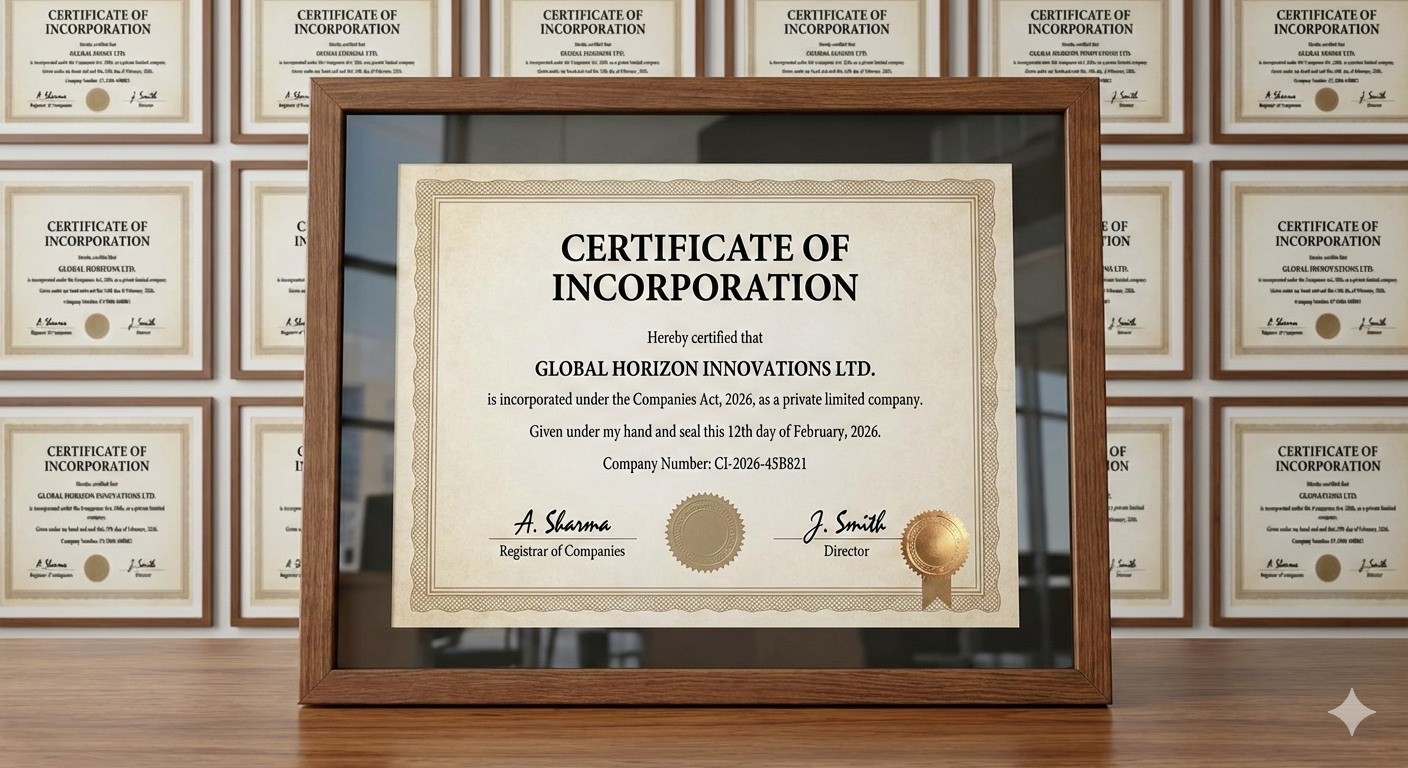
Form INC-11 contains the company’s registered name, registration number, incorporation date, jurisdiction (state), company classification, and the Registrar’s authenticated seal and signature.
6. Corporate Identity Number (CIN)
Section 7(3) mandates allotment of a unique 21-character alphanumeric CIN effective from the incorporation date. Unlike the company name which can change, the CIN remains permanent throughout the company’s existence, enabling unambiguous identification across all regulatory systems.
7. Tax Integration
Rule 18 requires inclusion of PAN on the certificate, reflecting integration with income tax infrastructure and enabling immediate tax compliance and banking operations.
The certificate serves as conclusive proof that all statutory requirements were satisfied. Once issued, incorporation validity cannot be challenged on grounds of procedural defects, protecting third parties dealing with the company in good faith.
8. Preservation Obligations
Section 7(4) imposes a perpetual obligation to maintain and preserve all incorporation documents at the registered office until dissolution. This ensures foundational documents remain accessible for regulatory inspection, legal proceedings, and historical verification throughout the company’s lifecycle, potentially spanning decades.
Penalty & Punishment
Individual Criminal Liability (Section 7(5))
Any person furnishing false information or suppressing material facts faces liability under Section 447 (fraud), which prescribes:
Extended Liability (Section 7(6))
Promoters, first directors, and certifying professionals face additional liability under Section 447 if the company is later proved to have been incorporated fraudulently, even if they weren’t personally responsible for the specific false information. This creates joint and several liability for key actors who bear special responsibility for incorporation integrity.
Disclaimer: The information contained in this Article is intended solely for personal non-commercial use of the user who accepts full responsibility of its use. The information in the article is general in nature and should not be considered to be legal, tax, accounting, consulting or any other professional advice. We make no representation or warranty of any kind, express or implied regarding the accuracy, adequacy, reliability or completeness of any information on our page/article.