
Background
The Gujarat Occupational Safety, Health and Working Conditions Rules, 2025, have been framed under the Occupational Safety, Health and Working Conditions (OSHWC) Code, 2020, a central legislation that consolidates and modernizes multiple earlier labour laws related to workplace safety, health, and welfare. The central Code provides a uniform framework for occupational safety and welfare but allows states to make detailed rules for implementation within their territories. Gujarat’s rules specify procedures for registration, certification, audits, and compliance, ensuring establishments adhere to safety and health standards. They apply to factories, construction sites, and other establishments covered under the Code, including contract and migrant workers. By streamlining regulatory requirements and setting clear responsibilities for employers, these rules aim to improve enforcement, protect workers, and enhance overall workplace safety. The state rules also provide mechanisms for inspections, reporting, and penalties to ensure adherence to the Code’s objectives. Through this framework, Gujarat aligns with national labour standards while addressing local industrial and workforce conditions effectively.
Applicability
The Gujarat Occupational Safety, Health and Working Conditions Rules, 2025, when read with the OSH Code, apply to:
Compliance Requirements under the Act in Accordance with the Rules
Employer shall submit the details of occupational safety and health statistics electronically on web portal designated for the purpose
Factories/Estab. with major hazards, hazardous processes (50 or more than 50 workers), factory wherein 250 or more than 250 workers employed, or more than 250 building workers must form a safety committee with employer and worker reps, incl. women. Tenure: 3 years. Worker representative chosen by trade union or workers if no union
Safety Committee shall have the right to be adequately and suitably informed of – (a) potential safety and health hazards to which the workers may be exposed at workplace; (b) data on accidents as well as data resulting from surveillance of the working environment and of the health of employees, conducted at such establishments/factories
Composition of Safety Committee in Gujarat
1)Management reps on Safety Committee include Manager/CEO-Chairman;Safety Officer- Secretary & Medical Officer & Reps.from production,maint, purchase dept. for factory & for construction-Reps.from engg/tech, plant, machinery, purchase
2)Common comm.:1 nominee/factory
3)Worker reps elected by workers
Functions of Safety Committee in Gujarat
Owner, employer, occupier, agent or manager shall, within a period of 15 days from the date of receipt of the recommendations of the Safety Committee shall take action to implement the recommendations.
Safety committee shall meet at least once in every quarter for factories and building or other construction work.
In case of mines, the safety committee shall meet at least once in a month.
In every ordinary factory, the employer shall appoint Safety Officers in the establishment as follow:-
For Factories carrying on hazardous process, the employer shall appoint Safety Officers as follow:-
a) In every Establishment which is a factory carrying on hazardous process wherein two hundred fifty workers or more are ordinarily employed, the employer shall also appoint such number of safety officers, who shall possess such qualifications and perform such duties, as may be prescribed by appropriate government b) Qualifications of a Safety Officer shall be as per Rule 21 of Gujarat OSH Rules 2025 c) Duties of a Safety Officer shall be as laid down in Rule 22 of Gujarat OSH Rules 2025
Major accident hazard factories must appoint Safety Officers as follows:
a) Any appointment, when made, shall be notified to the Inspector-cum-Facilitator having jurisdiction in the area, giving full details of the qualifications, terms and conditions of service of such safety officers. b) Qualifications of a Safety Officer shall be as per Rule 21 of Gujarat OSH Rules 2025 c) Duties of a Safety Officer shall be as laid down in Rule 22 of Gujarat OSH Rules 2025
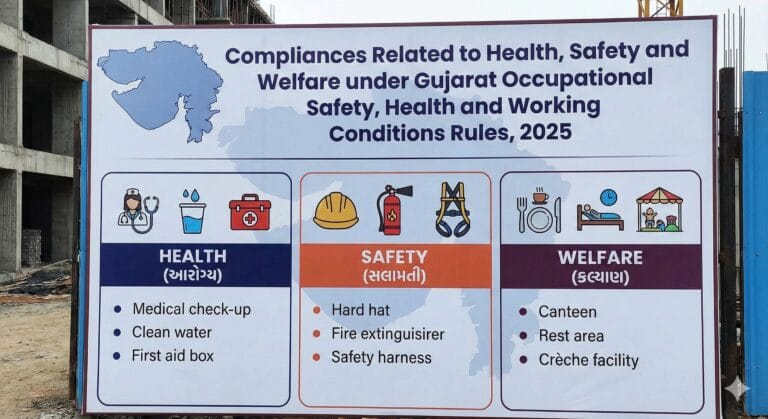
Employer shall be responsible to maintain in his establishment such health, safety and working conditions for the employees as may be prescribed by the Central Government.
Central Government may prescribe for providing all or any of the following matters in the establishment or class of establishments, namely:— (i) cleanliness and hygiene; (ii) ventilation, temperature and humidity; (iii) environment free from dust, noxious gas, fumes and other impurities; (iv) adequate standard of humidification, artificially increasing the humidity of the air, ventilation and cooling of the air in work rooms; (v) potable drinking water; (vi) adequate standards to prevent overcrowding and to provide sufficient space to employees or other persons, as the case may be, employed therein; (vii) adequate lighting; (viii) sufficient arrangement for latrine and urinal accommodation to male, female and transgender employee separately and maintaining hygiene therein; (ix) effective arrangements for treatment of wastes and effluents; and (x) any other arrangement which the Central Government considers appropriate.
Employer shall provide and maintain prescribed welfare facilities for employees, including: (i) Separate washing facilities for male and female employees; (ii) Separate bathing places and locker rooms for male, female, and transgender employees; (iii) Spaces for storing clothing not worn during work and drying wet clothing; (iv) Seating arrangements for employees required to work standing; (v) Canteen facilities in establishments employing 100+ workers, including contract labourers; (vi) Medical examinations for mine employees before employment and at specified intervals; (vii) Adequate first-aid boxes or cupboards accessible during working hours; (viii) Other welfare measures deemed necessary by the Central Government for a decent standard of living.
Wherein one hundred or more workers including contract labourers are ordinarily employed, employer shall provide canteen facilities in an establishment.
Employer to provide ambulance room facility in every factory, mine, building or other construction work wherein more than five hundred workers are ordinarily employed
Adequate, suitable and separate shelters or rest-rooms to be provided for male, female and transgender employees and lunch-room in every factory and mine wherein more than fifty workers are ordinarily employed and in motor transport undertaking wherein employee is required to halt at night
Central Govt, may prescribe for the appointment of welfare officer in every factory, mine or plantation wherein two hundred and fifty or more workers are ordinarily employed and the qualification, conditions of service and duties of such welfare officer
Facility of creche having suitable room or rooms for the use of children under the age of six years of the employees shall be provided at suitable location and distance either separately or along with common facilities in establishments wherein more than fifty workers are ordinarily employed
However an establishment can avail common crèche facility of the Central Government, State Government, municipality or private entity or provided by non-Governmental organisation or by any other organisation or group of establishments may pool their resources for setting up of common crèche in the manner as they may agree for such purpose
Penalty & Punishment
General Penalty u/s 94: For contravention, the employer or the principal employer of the establishment, as the case may be, shall be liable to penalty which shall not be less than two lakhs rupees but which may extend up to three lakh rupees, and if the contravention is continued after the conviction, then, with further penalty which may extend to two thousand rupees for each day till such contravention continues.
Disclaimer: The information contained in this Article is intended solely for personal non-commercial use of the user who accepts full responsibility of its use. The information in the article is general in nature and should not be considered to be legal, tax, accounting, consulting or any other professional advice. We make no representation or warranty of any kind, express or implied regarding the accuracy, adequacy, reliability or completeness of any information on our page/article.