
Background
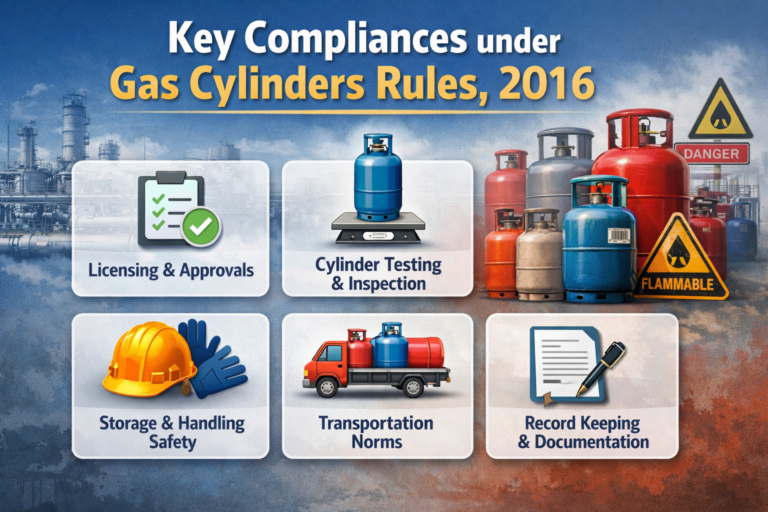
The Gas Cylinders Rules, 2016 were notified by the Ministry of Commerce and Industry under the Explosives Act, 1884 to regulate the import, manufacture, filling, possession, transport, and use of gas cylinders in India. They replaced the earlier Gas Cylinders Rules, 2004 to reflect advancements in cylinder technology, safety standards, and industry practices. The rules introduced stricter provisions on cylinder design, testing, certification, and licensing to minimize risks associated with storage and handling of compressed, liquefied, and dissolved gases. They also established clearer responsibilities for manufacturers, fillers, transporters, and users to ensure end-to-end safety compliance. Overall, the 2016 rules enhanced public safety and operational control across commercial, industrial, and domestic gas cylinder usage in India.
Applicability
These rules shall be applicable to:
Compliance Requirements under the Rules
No child under the age of eighteen years and no person who is in a state of intoxication shall be employed in-charge of loading or unloading or transport of any compressed gas cylinder or in any premises licensed under these rules.
(1) No person shall smoke and no fire, other than blow pipe flame for repairs, or no articles or such other substances of flammable nature or liable to spontaneous ignition or to cause or communicate fire or explosion shall be allowed at any time in proximity to a place where any cylinder for flammable gases is being filled, stored or handled.
(2) No person in or near any place where cylinders containing flammable gases are filled, stored or handled shall have in his possession matches, fuses, mobile phone or any other appliance for producing ignition or explosion.
(1) The cylinder shall be adequately supported during handling.
(2) Conveyors, trolleys and cradles of adequate strength shall, as far as possible, be used when moving the cylinders and care shall be taken to avoid any damage to the cylinder valve.
(3) The cylinders shall be handled carefully and not be allowed to fall upon one another or otherwise subjected to any undue shock
(4) Sliding, dropping or playing with cylinders is prohibited.
(1) Liquefied petroleum gas cylinder and cylinders containing liquefiable gases shall always be kept in an upright position and shall be so placed that they cannot be knocked over.
(2) The cylinders used in horizontal position shall be so secured that they cannot roll.
(3) Open flames, lights, mobile phones, lighting of fires, welding and smoking shall be prohibited in close proximity to any cylinder containing flammable gases except those while in use for welding, cutting or heating.
(4) Working places shall not be classified as storage places for the purpose of licensing.
Adequate storage controls should be ensured to keep the cylinders in a well ventilated and fire resistant place
Licence shall not be necessary for:
(a) possession of any cylinder filled with a compressed gas by a carrier or other person for the purpose of transport in accordance with the provisions of these rules
(b) possession of cylinders for own use and not meant for sale or trading filled with,-
(i) any flammable and non-toxic gas when the total number of cylinders containing such gas does not exceed twenty five or the total weight of gas does not exceed 200 kg whichever is less, at a time;
(ii) any non-flammable non-toxic gas when the total number of such cylinders does not exceed two hundred at a time;
(iii) any toxic gas when the total quantity of such cylinders does not exceed five at a time;
(iv) acetylene gas contained in cylinder in dissolved state when the total quantity of such cylinder does not exceed twenty five at a time.
License under Rule 43 of Gas Cylinder Rules 2016 is required for possessing cylinders filled with compressed gas
Construction details of LPG storage shed: LPG cylinder storage shed shall be constructed from any nonflammable material having floor area of minimum 11 square meter for 1000 Kgs of LPG storage. Mastic flooring conforming to IS-1195/1196 shall be provided in the LPG cylinder storage shed. The ventilator area shall be minimum 10 % of the floor area. Minimum safety distances as specified in table given in condition 5a of Form F licence shall be maintained and minimum 1.8 M high brick masonry compound wall shall be provided all around the LPG storage shed maintaining minimum safety distances as specified in condition 5a of form F license. Compound wall gate width shall not be more than 1.2 M. Dedicated LPG cylinder truck parking area in front of LPG cylinder storage
Penalty & Punishment
Rule 57: Suspension and cancellation of licence or approval.- (1) Every licence or approval granted under these rules shall be liable to be suspended or cancelled by an order of the licensing authority for any contravention of the provisions of the Act or rules framed there under or of any condition contained in such licence, or by an order of the Central Government, if at any time the continuance of the licence in the hands of the licensee is deemed objectionable
The Rules are silent about penalties so focus shifts on the governing Act viz. The Explosives Act 1884. Section 9B(1)(b) of the Act provides for the following penalty for contravention of rules made under Section 5 (i.e rules governing the conditions subject to which License was granted, the manufacture, possession, use, sale, transport, import and export of explosives, or any specified class of explosives): shall be punishable with imprisonment for a term which may extend to two years or with fine which may extend to three thousand rupees or with both
Disclaimer: The information contained in this Article is intended solely for personal non-commercial use of the user who accepts full responsibility of its use. The information in the article is general in nature and should not be considered to be legal, tax, accounting, consulting or any other professional advice. We make no representation or warranty of any kind, express or implied regarding the accuracy, adequacy, reliability or completeness of any information on our page/article.