
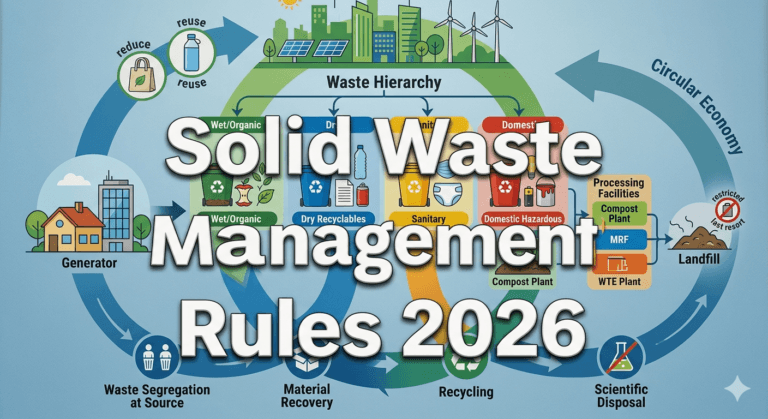
Key Compliances under Solid Waste Management Rules, 2026

Background

The rules provide for the levy of environmental compensation based on the ‘Polluter Pays’ principle for non-compliance, including cases of operating without registration, false reporting, submission of forged documents or improper solid waste management practices. The Central Pollution Control Board (CPCB) will prepare the relevant guidelines, while State Pollution Control Boards and Pollution Control Committees will levy the environmental compensation.

Applicability

These rules shall apply to every urban body as well as rural local body, including all entities within their jurisdictions whether being controlled and managed by the government; private sector or in Public Private Partnership; special notified areas; notified industrial areas or townships; special economic zones; food parks; areas under the control of Indian Railways including railway stations, railway tracks and land parcels adjacent to railway tracks; airports; airbases; harbours and ports including dry ports; defence establishments; public and private establishments; State and Central Government organisations; places of pilgrim, religious and historical importance and all land owners public or private, individual or body corporate in possession of land parcels, and to every domestic, institutional, commercial and any other non-residential solid waste generator. The rule does not cover industrial waste, hazardous waste, hazardous chemicals, bio medical waste, e-waste, battery waste and radio-active waste, that are covered under separate rules framed under the Environment (Protection) Act, 1986.

Compliance Requirements under the Rules

  • Duties of Waste Generators for Solid Waste Management (Rule 5 (1))
    Every waste generator shall,—
    (a) adopt measures to prevent or reduce solid waste pollution;
    (b) segregate waste into wet, dry, sanitary and special care streams and hand over to authorised collectors;
    (c) securely wrap used sanitary waste and dispose of it in the sanitary waste bin separated
    (d) store construction and demolition waste separately and dispose of it as per the Environment (Construction and Demolition) Waste Management Rules, 2025;
    (e) store horticulture/garden waste separately and dispose of it as per directions of local authorities;
    (f) not throw, burn, bury, or dispose solid waste on streets, public places, drains, or water bodies;
    (g) every street vendor shall keep suitable containers for waste and deposit it at notified depots, containers, or vehicles;
    (h) pay user fees for solid waste management as per local body bye-laws;
    (i) keep suitable containers for segregated waste and hand over to authorised collectors or vehicles;
    (j) not organise gatherings of more than 100 persons at unlicensed places without prior intimation and ensure segregation and proper disposal of waste;
    (k) not mix biomedical waste with solid waste, where applicable under Biomedical Waste Management Rules, 2016.
  • Obligations of Gated Communities, Institutions and Establishments for Waste Management (Rule 5 (2))
    All gated communities and institutions with more than 5,000 sq.m. area and all resident welfare associations, market associations, hotels, restaurants, shall, within one year from the date of notification of these rules in the Official Gazette and in partnership with the local body, ensure segregation of waste at source by the generators as prescribed in these rules, facilitate collection of segregated waste in separate streams, handover recyclable material to either the authorised waste pickers or the authorised recyclers. The bio-degradable waste shall be processed, treated and disposed of through composting or bio-methanation within the premises as far as possible. The residual waste shall be given to the waste collectors or agency as directed by the local body.
  • Registration Certificate of Bulk Waste Generators (Rule 6 (a))
    Every bulk waste generator shall register with the concerned local body via the centralised portal, comply with conditions in the registration certificate, and notify the local body of any changes in registration details or conditions.
  • Additional Obligations of Bulk Waste Generators for Waste Management and Compliance (Rule 6)
    Every bulk waste generator shall—
    a) hand over dry, sanitary and special care waste to authorised agencies;
    b) process wet/horticulture waste through decentralised approved methods;
    c) set up wet waste processing (new generators) or obtain exemption and processing certificates (existing generators).
    (e) fulfil Extended Bulk Waste Generator Responsibility for wet waste processing and environmentally sound management of dry, sanitary and special care waste, as per CPCB norms;
    (f) procure Extended Bulk Waste Generator Responsibility Certificates from the local body for collection, transport and processing of waste where wet waste is not processed on-site;
    (g) not engage with unregistered entities;
    (i) hand over residual waste or inerts from decentralised processing to authorised collectors or local body;
    (j) promptly remove and manage waste generated during construction in compliance with these rules;
    (k) ensure no littering during transport and manage waste at transit points for public transport entities;
    (l) develop and operate waste collection, processing or disposal facilities for construction, infrastructure and public facility projects;
    (m) not mix biomedical waste with solid waste and report biomedical waste quantities in annual returns, where applicable.
  • Submission of Annual Return by Bulk Waste Generators (Rule 6 (h), 20)
    Bulk waste generators shall submit annual returns by 30 June on the centralised portal for Extended Bulk Waste Generator Responsibility, including responsibility certificates, to local bodies, which shall publish the returns annually on their website.
  • Extended Bulk Waste Generator Responsibility certificate (Rule 10)
    Extended Bulk Waste Generator Responsibility certificates generated by the local body in a particular year shall be valid for meeting the obligations of bulk waste generators for a period of three years.
  • Duties of industrial units & Waste to Energy plants near RDF plants using solid waste. (Rule 11)
    Industrial units using solid fuel shall use refuse-derived fuel, segregated combustible fraction or agri-residue as specified, and units within prescribed distance from a refuse-derived fuel plant shall replace solid fuel with combustible fraction produced from solid waste meeting CPCB standards.

(1) All Refuse-Derived Fuel plants and Material Recovery Facility cum Refuse-Derived Fuel plants shall register and report availability of Refuse-Derived Fuel along with quality report of the available Refuse-Derived Fuel or Segregated Combustible Fraction as per guidelines issued by Ministry of Housing and Urban Affairs, on the centralised online portal on a monthly basis.
(2) Refuse-Derived Fuel plants to report real time on the availability and off take of Refuse Derived Fuel through centralised online portal.
(3) Refuse-Derived Fuel or Segregated Combustible Fraction plants supplying waste to WtE Plants to ensure that the calorific value is at least 1500 Kcal/kg.
(4) Refuse-Derived Fuel or Segregated Combustible Fraction plants supplying waste to Cement Plants to ensure that the calorific value is 3000 Kcal/kg.

  • Registration and Annual Return Filling of Use of Alternative Solid Fuels (Rule 11 (2))
    All industrial units utilizing Refuse-Derived Fuel or Segregated Combustible Fraction or agri-residue instead of solid fuel shall register with the concerned SPCB and shall file annual returns on use of Refuse-Derived Fuel (RDF) or Segregated Combustible Fraction (SCF) or agri residue through centralised online portal by 30th June every year.
  • Form-VI: Reporting of Accident at solid waste processing/treatment/disposal facility/land-fill site (Rule 21)
    In case of an accident at any solid waste processing or treatment or disposal facility or landfill site, the Officer- in- charge of the facility shall report to the local body in Form VI and the local body shall review and issue instructions if any, to the in- charge of the facility.

Penalty & Punishment

Rule 17: Imposition of Environmental Compensation:

The Environmental Compensation shall be levied based upon polluter pays principle on persons, who are not complying with the provisions of these rules, including the following activities:-

(a) entities carrying out activities without registration as mandated under these rules;

(b) entities providing false information or wilful concealment of material facts by the entities registered under these rules;

(c) entities submitting forged or manipulated documents by the entities registered under these rules;

(d) entities engaged in collection, segregation, sorting, transportation, processing and disposal of solid waste


Disclaimer: The information contained in this Article is intended solely for personal non-commercial use of the user who accepts full responsibility of its use. The information in the article is general in nature and should not be considered to be legal, tax, accounting, consulting or any other professional advice. We make no representation or warranty of any kind, express or implied regarding the accuracy, adequacy, reliability or completeness of any information on our page/article. 

To stay updated Subscribe to our newsletter today

Explore other Legal updates on the 1-Comply and follow us on LinkedIn to stay updated 

Post Views: 22

Schedule A Demo