
Key Compliances under Employees’ Provident Funds and Miscellaneous Provisions Act, 1952
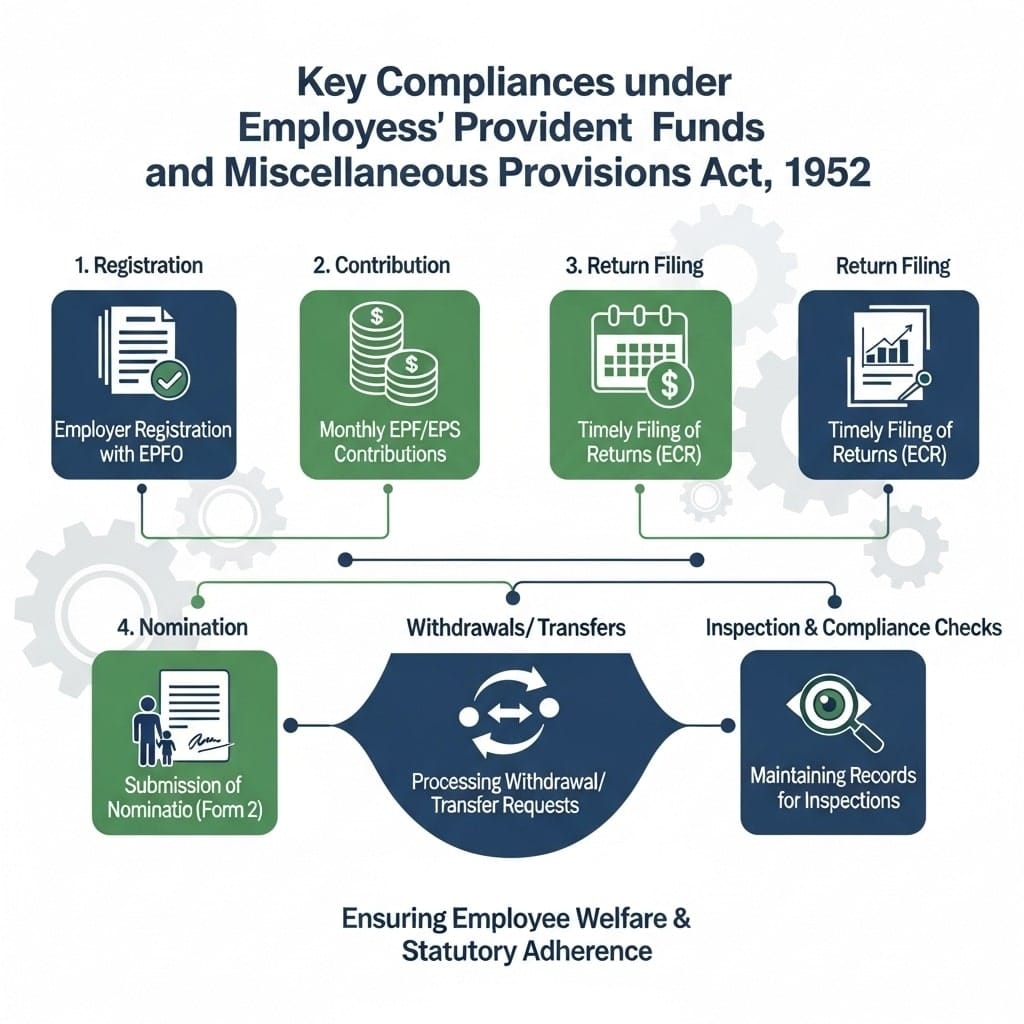
The Employees’ Provident Funds and Miscellaneous Provisions Act, 1952 was introduced to ensure financial security and social welfare for
Labour Identification Number (LIN)

Government of India plans to do away with all employer codes being issued by separate labour enforcement agencies such as ESIC, EPFO, CLC(C) and DGMS etc. by replacing them with new Labour Identification Number (LIN). Labour Identification Number (LIN) is
Haryana Industrial Disputes (Punjab) Rules, 1958

The Haryana Industrial Disputes (Punjab) Rules, 1958 were framed under the Industrial Disputes
Forms under Gujarat Labour Laws

Gujarat labour compliance forms—one‑stop index mapping Act/Rule to official form, operational trigger, and ready‑to‑use template links for audit‑ready documentation.
Key Compliances under Gujarat Factories Rules, 1963
The Gujarat Factories Rules, 1963 were framed under the enabling provisions of the Factories Act, 1948 with the objective of ensuring the health, safety, and welfare of workers employed in factories across the state of Gujarat. These Rules provide detailed procedures, registers, forms, and compliances that complement the substantive provisions of the parent Act. While the Factories Act lays down general standards, the Gujarat Rules operationalize them with state-specific requirements such as licensing procedures, record-keeping formats, safety measures, fire precautions, medical facilities, welfare amenities, accident reporting, and annual/half-yearly returns. Over time, amendments have been introduced to align these Rules with evolving industrial practices, hazardous process management, and occupational safety standards.
Consolidated Annual Return – Gujarat
To make compliance with labour laws simpler and to avoid the duplication of effort by employers, the Government of Gujarat introduced a Consolidated Annual Return system. Instead of submitting multiple separate returns under different labour legislations, employers now have the option to file one combined return along with maintaining integrated registers.
Gujarat Maternity Benefit Rules, 1964

The Maternity Benefit Act, 1961 was enacted to regulate the employment of women during and after pregnancy, ensuring they receive adequate rest, financial security, and protection from workplace discrimination. It mandates paid maternity leave, medical bonuses, nursing breaks, and prohibits dismissal during maternity-related absence. To operationalize this Act in Gujarat, the Gujarat Maternity Benefit Rules were introduced. These rules prescribe the forms, registers, muster rolls, payment procedures, preservation of records, display of abstracts, and other state-specific compliance mechanisms. Together, the Act and the Rules provide a detailed framework that safeguards maternal health, promotes workplace equality, and sets out obligations for employers.
Gujarat Payment of Wages Rules, 1963
The Payment of Wages Act, 1936 was enacted to regulate the timely payment of wages and prevent unauthorized deductions, ensuring fair treatment of workers. Prior to its enactment, workers often faced exploitation in the form of delayed wages and arbitrary deductions. To implement the provisions effectively at the state level, the Gujarat Payment of Wages Rules, 1963 were introduced. These rules provide detailed procedures for maintaining registers, submitting returns, regulating fines and deductions, granting advances or loans, and displaying statutory notices. Together, the Act and the Rules form a comprehensive framework for wage regulation in Gujarat.
Rajasthan Payment of Wages Rules, 1961
The Payment of Wages Act, 1936 was enacted to regulate timely payment of wages and prevent unauthorised deductions. To enforce its provisions in Rajasthan, the Rajasthan Payment of Wages Rules, 1961 were framed. These Rules prescribe registers, forms, notices, and procedures related to fines, deductions, wage slips, and displays, ensuring transparency in wage disbursement and accountability of employers.
Rajasthan Contract Labour (Regulation and Abolition) Rules, 1971
The Rajasthan Contract Labour (Regulation and Abolition) Rules, 1971 were framed under the Contract Labour (Regulation and Abolition) Act, 1970 with the objective of regulating the employment of contract labour in establishments and providing safeguards for their welfare. These Rules lay down procedures for registration of establishments, licensing of contractors, conditions of service, health and safety provisions, and record-keeping. The intent is to prevent exploitation of contract labour while ensuring compliance with statutory standards of working conditions in Rajasthan.